Showing posts with label an. Show all posts
Showing posts with label an. Show all posts
Saturday, April 30, 2016
HTML Tutorial 5 Basic Elements on An HTML Form Part 1
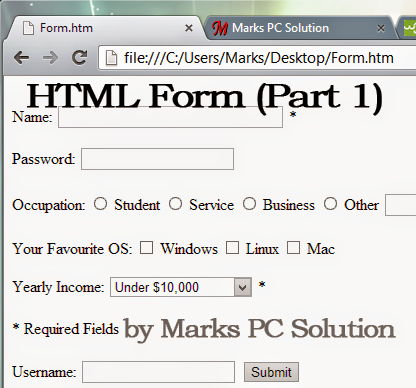
Few months ago, I started writing about HTML. There are already 4 tutorials published on HTML. I know this is not sufficient for an HTML learner. Because learning HTML requires much resources and practice. However I will try to write about HTML whenever Im able to manage time.
You can also read the previously published HTML Tutorial:
- Tutorial 1
- Tutorial 2
- Tutorial 3
- Tutorial 4
Todays HTML tutorial is very easy, funny and useful. Today I will discuss about the basic elements of an HTML form. This is the part 1 that includes Text Fields, Password Field, Radio Buttons & Checkboxes.
How to Start:
You can practice using notepad. Press Start + R > Type Notepad > Enter. Now copy or type the code from here. And save them as form.htm or use any other name. But the name should end with either .htm or .html. Then open the file in a browser.
Lets begin -
Usually an HTML form contains input elements like text fields, checkboxes, radio buttons, submit buttons etc. To create an HTML form you must use the <form> tag. Look at the structure below:
<form>
input elements
</form>
Though you skip the <form> tag, modern browsers can identify your form. But this is a basic rule for creating html forms. So you should start with <form> and end with </form>.
Text Fields:
<input type="text"> indicates a one-line input field to enter text.
<form>First name: <input type=text><br>Last name: <input type=text></form>
The result will be as below:
Note: <br> tag is used to create line break. Otherwise both fields will appear in a single line. The default width of a text field is 20 character. You can increase it as below:
The result will be:
<form>Name: <input type=text size = 40><form>
The result will be:
Radio Buttons:
<input type="radio"> refers to a radio button. Radio button allows user to choose a single item. After selecting an item, you can change it. But once selected, you cant undone it.
<form>Which one do you like most?<input type=radio name=Mobile>Nokia<br><input type=radio name=Mobile>Samsung<br><input type=radio name=Mobile>Apple</form>
You will get:
Checkboxes:
<input type="checkbox"> defines a checkbox. Somewhat similar to radio buttons. But here an user can choose multiple items. And he can deselect the item any time!
<form>What is your Favorite Browser?<input type=checkbox>Google Chrome<br><input type=checkbox>Firefox<br><input type=checkbox>Internet Explorer<br><input type=checkbox>Opera<br><input type=checkbox>Other<br></form>
Your browser will show:
These are some important elements of an HTML form. There are few other elements remaining. I will try to write about those elements in the next post. And then Ill put these all together and show you how to prepare an HTML form. Till then, stay with us . . .
Stay with Marks PC Solution to get more interesting IT topics!


Friday, April 29, 2016
Caffeine to Hummingbird An Upgrade to Google Search Algorithm!

Most of the internet users have no idea about how the search engine works. The system that a search engine applies to find the relevant results among millions of websites is called Search Algorithm. Whether you will find an appropriate result from a search depends on the algorithm. With a powerful Search Algorithm, Google is the top search engine of the world. And recently a new search algorithm, called Hummingbird, has been launched by the search giant.
Septermber 26, 1998. The starting of Google. And just yesterday, Google celebrated their 15th Birthday. This birthday was not a mere celebration actually. Moreover it comes with an annoucement of major change in Google Search Engine Algorithm. Its been 3 years since Google made a major change in their search algorithm named as Caffeine. And the new one, Hummingbird, has been lunched one month ago.
Amit Singhal, senior vice president of search, said on Thursday- the company launched its latest "Hummingbird" algorithm about a month ago and that it currently affects 90 percent of worldwide searches via Google.
Whats New in Hummingbird?
- Capable of handling large and complex queries
- Precise and Faster Processing of Queries
- Focus on the meaning behind the query words
- Pay more attention to earch word in a query
- Consider the relevance of the pages rather than focusing on the page rank only.
- Improved converstional search (People When Speaking Searches)
These are all Ive been able to gather about Hummingbird. Because, Google didnt inform much about it. Ive collected those information from different websites. Lets discuss some other issues:
What about Pagerank?
Most of you know that pagerank indicates the overall quality of a site. But in Google search, pagerank is not everything. There are more than 200 search signals used by Google to sort search results. And pagerank is one of them.
Hummingbird considers pagerank too. But it emphasizes on the relevance of the query. If the search query matches your contents, no matter who you are and what is your ranking, you will be the in the first page. And thats how Marks PC Solution competes with storng sites even with a page rank 0.
Is there any Feature of Caffeine?
Sure! Some parts of old search algorithm is still being used by Hummingbird. It just changes the unncessary parts and adds some new. But nobody can guarantee about the old parts. Because they could be changed anytime if Google finds something better.
What Happened to Updates like Penguine, Panda etc?
From time to time, Google updated their algorithm. Sometimes they added new tools like penguine, panda etc. Some of them are being cosidered as the parts of old engine in a new engine. I mean, these were not changed entierly.
What about SEO?
As the search algorithm changes, SEO experts and site developers may think of change in ther optimization techniques. Though Google assures that no change is necessary. It said there is nothing to worry about SEO.
But I personally dont believe this. Definitely the new algorithm will affect the search appearance of a site either positively or negatively.
So far I know, Hummingbird doesnt hamper the search result position of Marks PC Solution. My suggestion is- Increase your Google+ Sharings. Grow your followers in Google Plus if youd like to be favoured by Google!
But I personally dont believe this. Definitely the new algorithm will affect the search appearance of a site either positively or negatively.
So far I know, Hummingbird doesnt hamper the search result position of Marks PC Solution. My suggestion is- Increase your Google+ Sharings. Grow your followers in Google Plus if youd like to be favoured by Google!
Stay with Marks PC Solution to get more interesting IT topics!
Wednesday, April 13, 2016
HOW TO CREATE AN ENVIRONMENTAL THEME T SHIRT DESIGN IN MS WORD
MICROSOFT WORD DRAWING PROJECT No. 31
TITLE: HOW CREATE AN ENVIRONMENTAL THEME T-SHIRT DESIGN IN MS WORD
TYPE: GRAPHIC DESIGNI still remember the time when a can opener was one of the most important utensils in the kitchen. Before the 1980’s, most canned food could only be opened with the can opener. Even a child nowadays can open a can easily just by lifting the tab attached to the lid and pull backwards to remove it. I happened to open a can of peanuts one day and after observing the lid for quite some time, I was struck by the idea of using this lid as the subject for a graphic design. In this project, I used a throwaway object as the subject for a t-shirt design where the concept of the design is “Recycle for the Conservation of Our Natural Environment”. Actually, readers can get plenty of ideas for visual art projects by observing nature and man-made objects around us.
Readers can refer to MS Word Drawing Project No. 15 for tips on how to draw a plain t-shirt. After creating the design, paste it on the t-shirt. Below is the graphic design created with Microsoft Word 2007 drawing program. I used only four tools to draw it. These tools are: Oval, Block Arc, Curve line, and Moon. I also used WordArt to insert the curved shape text into the drawing. Make use of the shadow effects to create emboss or bevel effects to enhance the illustration’s appearance.

This is a simple graphic design with the underlying message that recycling helps to curb pollution and gives us a brighter future and I’m sure that we all want that.

This is how the finished drawing looks like when the design is placed on the t-shirt.
Wednesday, April 6, 2016
HOW TO DRAW AN ICE CREAM IN MS WORD
MICROSOFT WORD DRAWING PROJECT No. 7
TITLE : AN ICE CREAM WITH TWO FLAVOURS
TITLE : AN ICE CREAM WITH TWO FLAVOURS
TYPE : ILLUSTRATION

I think that most people love to eat ice cream. Well, MS Word can draw an ice cream that looks delicious too. I will take a break from drawing scientific diagrams and come back to that later. The drawing objects needed to create the picture of the ice cream like the one above are as follows: Arc, Oval, Rounded Rectangle,
and Curve line.
1/3

The three diagrams above show how the drawing is done. Notice that the Arc is very useful for creating hemispheric shapes. The Arc can also be filled with colour even though it is not a closed shape. Of course you will have to use the Order commands to adjust the position of the drawing objects.
2/3

Rendering colours to the illustration enhances its appearance. Make use of the Paint Bucket tool to colour the drawing objects. I used Brown, Orange
3/3
Tuesday, March 29, 2016
How to burn an ISO disk image through Nero
An ISO disk image file (also known as simply an ISO image file) is an executable file that you can burn (write) to a blank, recordable CD or DVD. After you burn an ISO file to a blank disk, it is similar to any installation CD or DVD that lets you install a product, such as a single software program or a complete operating system. For more information, see Wikipedia ISO Image.

Although the procedure below applies specifically to Nero Express 6, it applies generally to most programs through which you can burn ISO image files to blank disks. To burn an ISO image file through Nero, do the following:
- If you have not already done so, install Nero. For example, you can download and install a free version, such as Nero 9 Lite.
- Insert a blank, recordable disk (CD or DVD) into the burner (DVDRW drive) through which you wish burn your ISO image file.
- Double click on your Nero StartMart desktop icon to start Nero and display its window.
- Select (move your mouse over) the Copy and Backup icon, and then click on Burn Image to Disk to display the "Open" window.
- Use the "Files of type" drop-down menu to select Image Files (*.nrg;*.iso;*.cue).
- Navigate to the ISO file that you wish to download, select it, and then click on the Open button to display the "Nero Express Image recorder" window.
- Use the "Destination drive" drop-down menu to select the drive into which you placed your blank disk.
- Select (check mark) Verify data on disk after burning.
- Click on the Next button to start the burning process and display its window, which shows "Process status" and "Remaining time." (The entire burning and verifying process might take approximately 30 minutes. Of course, while waiting, you can minimize the recorder window and perform other tasks.)
- After Nero burns your ISO image file, click on the Next button to eject the disk, and then click on the Exit button to close Nero Express and redisplay the "Nero" window.
- Close the "Nero" window.
Friday, March 25, 2016
Create an Official Facebook Page for Website Person or Place

Facebook Fan Page is a very common way to communicate with public. Almost all major organizations, websites, places or brands have their own Facebook page. You can also create a Facebook page for your business, blog or website. This is very easy and free of cost!
To create a Facebook page go to the link below. Before that make sure youre signed in to your Facebook account.
Create a Page
There are six types:
- Local Business or Place
- Company, Organization or Institution
- Brand or Product
- Artist, Band or Public Figure
- Entertainment
- Cause or Community
Select any of the types which is suitable for you. Then choose your page category and give it a name. Agree with the terms and conditions and hit on Get Started.
Now do the followings:
- Set a profile picture
- Give a description of it
- Set a Facebook address
- Enable Ads or Skip it
Now your page is almost ready. Invite your friends to like it. Try to build audience. You will find several options to build audience and to invite friends to like it.
Keep posting for the audience. Post only necessary contents. So that people find it useful. It will help to grow the page quickly. Never abuse it.
Like us on Facebook
Stay with Marks PC Solution to get more interesting IT topics!
Tuesday, March 15, 2016
HOW TO DRAW HALF AN APPLE IN MS WORD PART 4
MICROSOFT WORD DRAWING PROJECT No. 30 PART 4
TITLE: HOW TO DRAW HALF AN APPLE IN MS WORD
TYPE: STILL LIFE DIGITAL DRAWING(C) HOW TO COLOUR IT?
Make use of the Gradient effects in the Shape Fill group. Experiment with the Light Gradient Variations and Dark Gradient Variations to get the desired effects.

(D) THE STILL LIFE COMPOSITION
I have created a simple still life composition with the half apple image to demonstrate that digital drawings can be combined with photographic images to create visual art compositions. I snapped a picture of the marble table top at the angle of 45° which is actually the proper angle for perspective view. I then pasted the illustration onto the photographic image. You can see that the half apple is viewed below you eye level. Don’t forget to add some shadow effects to make it look more realistic. Notice that Ive used value contrasts in this composition. When a darker colour object like the apple is placed on something with a lighter colour, say, a piece of yellow coloured paper, the object with the darker colour stands out or seems more vivid, and vice versa. The knowledge of Basic Colour Theory is useful because it can be applied in fine art and graphic design to produce wonderful works of art. You’ll find terminology such as Colour Wheel, Spectrum, Hue, Primary Colours, Secondary Colours, Tertiary Colours, Value, Harmonic Colours, Complementary Colours, Colour Intensity, Warm and Cool Colours, Neutral Colours, and so on.


I love to use landscape or seascape scenery pictures as background for PowerPoint slides. Since the picture above is a bit darker, the used of Dark Blue which is also of a darker value for the text is not suitable because it doesn’t stand out from the background. A PowerPoint presentation with obscure text is the last thing we want, right?

The picture above has a lighter value and therefore the used of Dark Blue which is of a darker value for the text is suitable because it stands out from the background. A PowerPoint presentation with vivid text is just the thing that we want.
Monday, March 14, 2016
The Overfeeding Overview High Fat Carb Protein MCTs Leptin Testosterone T3 Reverse T3 Get an Overview of the Consequences of Short Long Term Overfeeding
 |
| High fat + high carbohydrate foods like mini doughnuts are exactly what you should not eat on a refeed day, let alone during weeks of bulking. |
Yes? In this case, I would suggest you take a closer look at the following overview of the research. An overview that is probably not complete, but it should suffice to provide preliminary answers to the aforementioned questions.
Learn more about the effects of your diet on your health at the SuppVersity

Only Whey, Not Soy Works for Wheytloss

Taste Matters - Role of the Taste Receptors
 Dairy Protein Satiety Shoot-Out: Casein vs. Whey
How Much Carbs Before Fat is Unhealthy?

5 Tips to Improve & Maintain Insulin Sensitivity

Carbohydrate Shortage in Paleo Land
- The amount of weight you gain depends on your genes: They are not the only determinant. Thats for sure. A 1990 study by Bouchard et al. still leaves no doubt that your genes are one of the most important determinants of the quantity of weight you gain.
In said study the researchers from the Laval University fed 24 sedentary young male twins 1,000kcal extra for six out of seven days of the week. In that the study is not the first to investigate the effects of overfeeding on weight gain in twins. It is yet the first and only one that did this over a period of 100 days and thus with a total energy excess of 84,000 kcal on a diet that contained 50 percent carbohydrate, 35 percent fat, and 15 percent protein.
The data in Figure 1 does probably not need any extra explanations. In view of the fact that similar results have also been observed in previous studies like Poehlman et al. (1986), it should be obvious that the difference between the weight (left) and visceral fat (right) two identical twins gained was significantly smaller the difference between one twin from pair A and one twin from pair B. The statistical analysis of body fat and waist circumference data revealed similar correlations which were most significant for the visceral fat mass and the waist hip sizes, i.e. those quantities that predict the ill health effects of weight gain best.
Figure 1: Comparison of the weight (left) and visceral fat (right) gains in twin pairs; high correlations were observed for both, but the correlation was significantly more pronounced for the unhealthy visceral fat than it was for the mere body weight (Bouchard. 1990).
According to Ukkola, et al. (2001), the genetic differences may partly be mediated by differences in the genetic make-up of ones beta-2 adrenoreceptors with specific variants being associated with greater increases in insulin resistance, body weight and subcutaneous fatness. Other candidates are the cholesterol ester transfer protein (CETP) gene which appears to affect adiposity in response to long-term overfeeding (Terán-García. 2008). Other scientists use similar genetic polymorphisms to explain a general resistance to weight gain during overfeeding via genetically determined variations in nonexercise activity thermogenesis (Vanltallie. 2001). - Overfeeding fat, carbohydrate or protein, does it make a difference? Studies that compare isocaloric overfeeding are quasi non-existent. What we do have are studies like the one by Horton et al. (1995) that compared high fat vs. high carbohydrate diets (see Figure 2 for macronutrient composition), where the additional energy came from fat or carbohydrates.
In the Horton study this was a 50% extra that was added in form of fat or carbohydrates on top of the baseline diets of the normal-weight and obese subjects. A 50% extra that lead to significant weight gain.
As you can see in Figure 3, both diets led to a rapid increase in body weight, but the trajectory was different. The main and maybe practically relevant difference, though, was that the rapid increase in water and glycogen in the high carbohydrate group was less resilient weight loss in the post-overfeeding period.
Figure 3: Weight gain (left) and increase in energy expenditure (right) in obese and lean subjects in response to carbohydrate and fat overfeeding (Horton. 1995).
No! Carbs are not necessarily more fattening in the obese. Its a commonly held prejudice that carbohydrates are more readily coverted to fat and stored in the obese, but a study by Minehira et al. that investigated just this found that there was not just no difference in de novo lipogenesis with carbohydrate overfeeding between lean and obese individuals, there was also no increase in de novo lipogenesis, at all, when the when the obese subjects were overfed with a high carbohydrate diet for one day (Minehira. 2004).
If we take a look at the proportion of energy that was stored as body fat in Figure 4, it is obvious why the fat gains lasted longer than the carbohydrate gains. Why? Well, simply because the 14-day overfeeding on fat lead to a significantly higher relative increase in body fat.
Figure 4: Proportion of the energy that was stored as body fat (Horton. 1995).
Last but not least, it may also be worth mentioning that the the fat gain in the obese group was 89% and 57% higher in the carbohydrate and fat overfeeding group, respectively. An intriguing result that appears to stand in line with dieting studies, where high fat diets are superior to high carbohydrate diets in the obese, but not in lean individuals.
What was not different for obese and lean individuals, though, was the the fact that the carbohydrate overfeeding lead to higher gains in lean mass than the fat overfeeding. A result that should remind you of a previously reported study here at the SuppVersity, in which a no fat bulk lead to significantly greater muscle and significantly lower fat gains than a low fat bulk (see "If You Go "High Carb", You Better Go Really High!" | more). Overall, "bulking", i.e. eating more than you need on any mixed diet, has repeatedly been shown to produce significant increases plasma Somatomedin-C/Insulin-like Growth Factor (SM-C/IGF-l) and testosterone concentrations as well as insulin, of which Forbes et al. speculate that they promote the lean mass increases that are particularly pronounced when overfeeding is combined with resistance training.
In a more nutrient-type specific study b by Dirlewanger that did not focus on the weight gain or anabolism, but on the leptin response and the increase in resting energy expenditure the subjects experienced a significant increase in leptin (+28%) and resting energy only in the high carbohydrate, yet not in the fat overfeeding arm of their study in young, lean individuals (Dirlewanger. 2000). Other studies, without clear distinction between high carb and high fat overfeeding, indicate that fast food like burgers or fries is an effective short-term leptin stimulator, too - at least if its consumed in a single binge (Kolaczynski,. 1996).
In the short run, like on refeed days, for example, carbohydrate overfeeding has another advantage over fat overfeeding, because it takes roughly 500g of carbohydrates (thats 2,000kcal) before even a single gram of those carbs is converted to fat and potentially, but not necessarily stored as body fat (Acheson. 1988) - at "only" 400kcal extra from carbs for one day there was no net lipogenesis at all (see Figure 5). This result is corroborated by data from McDevitt et al. (2000) who observed that the fat gain with fat overfeeding starts with day 1, while there is a time gap in the increase in body fat with carbohydrate overfeeding (McDevitt. 2000).
Figure 5: Energy partitioning in young men upon overfeeding with ~5,000kcal per day - mostly carbohydrates, i.e. 1% protein, 3% fat, and 86% carbohydrate (Acheson. 1988).
If you consume sugar on a refeed, should you prefer glucose, sucrose of fructose? In view of the fact that I dont suggest you refeed more than 1-2 days and considering the fact that you want to get the majority of your carbs from starches on a true bulks, it does not really matter. In fact, studies show no difference in de novo lipogenesis in 96h overfeeding studies between pure glucose and sucrose, which is a 1:1 combination of fructose or fructose in two studies in lean and obese women by (McDevitt. 2000 & 2001). In the long run, consuming amounts of fructose you could only get by drinking a couple of bottles of coke everyday, will yet not be favorable for your health - even if taking fish oil can blunt the increase in hepatic de novo lipogenesis, it wont blunt the insulin resistance (Faeh. 2005).
Fat overfeeding, on the other hand, has been show to favor fat storage not just because the dietary fat can be stored without being converted to triglycerides, but also because metabolic and genomic investigations show that the lipid oxidation rate tends to decrease, and 55 genes in the skeletal muscle were modified.
Figure 6: Schematic representation of the main lipid metabolic pathways affected in skeletal muscle during 4 weeks of fat overfeeding. Genes indicated in white boxes were down-regulated during the dietary study, whereas genes indicated in gray boxes were up-regulated (Meugnier. 2007).
Modifications of which Meugnier et al. show that they stimulate the synthesis of triacylglycerol, inhibit lipolysis and reduce the oxidation of fatty acid oxidation, while promoting the development of adipocytes with an excess of only ~550kcal/day from fat per day (see Figure 6).
Another potential explanation is the change in thyroid hormones, of which the data in Figure 7 from an overfeeding study by Danforth Jr., et al. (1979) tells you that the high protein overfeeding despite a 29.8% lower total energy intake triggered the most, the carbohydrate diet the 2nd most favorable (=in favor of greater energy expenditure) effects on the thyroid hormone.
Accordingly, high protein diets, of which we know for sure that they are the most satiating hypercaloric diets (followed by high carb and high fat | Johnstone. 1996) and have the highest thermogenic effect (see Figure 8) and can help dieters avoid the yoyo effect after a diet (Lejeune. 2005), should have the least negative impact on your physique.
Figure 7: Effects of overfeeding with carbohydrates, fats, and protein on thyroid hormones (Danforth, Jr. 1979).
And in fact, Jose Antonio et al. (2014) have recently been able to show that a diet that contains fivefold more protein than the FDA recommends (4.4g/kg | 307g/day) is not just benign but will, in conjunction with exercise, will have significant beneficial effects on the physique of healthy resistant trained men (learn more). Furthermore studies indicate that a high protein content may also ameliorate negative effects such as an increase in intrahepatocellular lipid deposition in humans (Bortolotti. 2009).
Figure 8: Estimates thermic effect of carbohydrates fats, protein, and alcohol in % energy of the energy thats ingested in form of the respective nutrients (Joosen. 2006).

- Classic overfeeding studies with protein as a single nutrient are yet unfortunately rare. Even less, namely nothing, is known about the effects of ketogenic diets, which is why its at the moment impossible to tell whether a hypercaloric high fat diet that is devoid of carbs and low enough in protein to actually induce ketosis will have the same negative effects as a high fat diet that still contains 15-30% carbohydrates and some protein.
Based on the studies we have, its yet quite certain that the combination of some carbs and a high amount of fat is the most obesogenic variety of "bulking" you could possibly select. Therefore - with the exception of ketogenic diets, where corresponding data is still missing, the rule of thumb is: The more fat in the diet, the more rapid the body fat, but not necessarily the body weight gain.
- MCT overfeeding is less obesogenic - The reason that rodents that are overfed with medium-chain triglycerides (Geliebter. 1983) and assumable human beings store less fat than on long-chain triglycerides as you will find them in your bacon, sausages, dairy & co is an increase in thermogenesis that has been observed in both rodent and human studies.
As you can see in Figure 10, this effect does not diminish over time - at least, when only the effect of the infusion of MCTs versus long-chain fatty acids is concerned. In view of the rodent study by Geliebter et al. (1983) and the results of the study by Hill et al. (1989), it appears to be quite obvious that MCTs constitute a valuable addition to hypercaloric diets. The often-heard claim that they cannot be stored as fat is yet misleading - even if they are oxidized in the liver, the increase in available energy will increase the storage of energy from other nutrients. The dream of eating as much as you want without gaining weight does therefore remain a dream - at least for all of us who dont harbor a gene defect that blunts the storage of fat.
Figure 10: Metabolic rate in healthy men after the ingestion of isocaloric fat meals containing MCTs or long chain triglycerides (Hill. 1989).
Still, in theory it would appear as if using MCTs in a dieting context makes sense. In reality, studies have shown that using MCTs as a major source of your dietary fats does not lead to significant long-term improvements in fat or general weight loss - even if 27% of an 800kcal/day starvation diet were pure MCT oil (Yost. 1989).
 |
| Fivefold More Than the FDA Allows: Extreme High Protein Diet (4.4g/kg | 307g/day) Benign & Non-Obesogenic. Plus: Macronutrient Prescription & Changes in Food Quality | more |
A protein and a high(er) carbohydrate, as well as a correspondingly low(er) fat content on the other hand, appear to be the way to go at least in the short run. In the long(er) run, on the other hand, the differences between higher fat and higher carbohydrate overfeeding appears to disappear - albeit with a small, but potentially practically significant difference in terms of the amount of body fat you will gain (see Figure 4) | Comment on Facebook!
- Acheson, K. J., et al. "Glycogen storage capacity and de novo lipogenesis during massive carbohydrate overfeeding in man." The American journal of clinical nutrition 48.2 (1988): 240-247.
- Antonio, Jose, et al. "The effects of consuming a high protein diet (4.4 g/kg/d) on body composition in resistance-trained individuals." Journal of the International Society of Sports Nutrition 11.1 (2014): 19.
- Bouchard, Claude, et al. "The response to long-term overfeeding in identical twins." New England Journal of Medicine 322.21 (1990): 1477-1482.
- Danforth Jr, E., et al. "Dietary-induced alterations in thyroid hormone metabolism during overnutrition." Journal of Clinical Investigation 64.5 (1979): 1336.
- Dirlewanger, M., et al. "Effects of short-term carbohydrate or fat overfeeding on energy expenditure and plasma leptin concentrations in healthy female subjects." International journal of obesity and related metabolic disorders: journal of the International Association for the Study of Obesity 24.11 (2000): 1413-1418.
- Faeh, David, et al. "Effect of fructose overfeeding and fish oil administration on hepatic de novo lipogenesis and insulin sensitivity in healthy men." Diabetes 54.7 (2005): 1907-1913.
- Forbes, Gilbert B., et al. "Hormonal response to overfeeding." The American journal of clinical nutrition 49.4 (1989): 608-611.
- Geliebter, Ae al, et al. "Overfeeding with medium-chain triglyceride diet results in diminished deposition of fat." The American journal of clinical nutrition 37.1 (1983): 1-4.
- Hill, James O., et al. "Thermogenesis in humans during overfeeding with medium-chain triglycerides." Metabolism 38.7 (1989): 641-648.
- Horton, Tracy J., et al. "Fat and carbohydrate overfeeding in humans: different effects on energy storage." The American journal of clinical nutrition 62.1 (1995): 19-29.
- Johnstone, A. M., R. J. Stubbs, and C. G. Harbron. "Effect of overfeeding macronutrients on day-to-day food intake in man." European journal of clinical nutrition 50.7 (1996): 418-430.
- Joosen, A. M., and Klaas R. Westerterp. "Energy expenditure during overfeeding." Nutr Metab (Lond) 3 (2006): 25.
- Kolaczynski, JERZY W., et al. "Response of leptin to short-term and prolonged overfeeding in humans." The Journal of Clinical Endocrinology & Metabolism 81.11 (1996): 4162-4165.
- Lejeune, Manuela PGM, Eva MR Kovacs, and Margriet S. Westerterp-Plantenga. "Additional protein intake limits weight regain after weight loss in humans." British Journal of Nutrition 93.02 (2005): 281-289.
- McDevitt, Regina M., et al. "Macronutrient disposal during controlled overfeeding with glucose, fructose, sucrose, or fat in lean and obese women." The American journal of clinical nutrition 72.2 (2000): 369-377.
- McDevitt, Regina M., et al. "De novo lipogenesis during controlled overfeeding with sucrose or glucose in lean and obese women." The American journal of clinical nutrition 74.6 (2001): 737-746.
- Meugnier, Emmanuelle, et al. "Changes in gene expression in skeletal muscle in response to fat overfeeding in lean men." Obesity 15.11 (2007): 2583-2594.
- Minehira, K., et al. "Effect of carbohydrate overfeeding on whole body macronutrient metabolism and expression of lipogenic enzymes in adipose tissue of lean and overweight humans." International journal of obesity 28.10 (2004): 1291-1298.
- Poehlman, Eric T., et al. "Genotype-controlled changes in body composition and fat morphology following overfeeding in twins." The American journal of clinical nutrition 43.5 (1986): 723-731.
- Roberts, Susan B., et al. "Effects of age on energy expenditure and substrate oxidation during experimental overfeeding in healthy men." The Journals of Gerontology Series A: Biological Sciences and Medical Sciences 51.2 (1996): B148-B157.
- Terán-García, Margarita, et al. "Effects of cholesterol ester transfer protein (CETP) gene on adiposity in response to long-term overfeeding." Atherosclerosis 196.1 (2008): 455-460.
- Ukkola, Olavi, A. Tremblay, and C. Bouchard. "Beta-2 adrenergic receptor variants are associated with subcutaneous fat accumulation in response to long-term overfeeding." International journal of obesity and related metabolic disorders: journal of the International Association for the Study of Obesity 25.11 (2001): 1604-1608.
- Vanltallie, Theodore B. "Resistance to weight gain during overfeeding: a NEAT explanation." Nutrition reviews 59.2 (2001): 48-51.
- Yost, Trudy J., and R. H. Eckel. "Hypocaloric feeding in obese women: metabolic effects of medium-chain triglyceride substitution." The American journal of clinical nutrition 49.2 (1989): 326-330.
Saturday, March 12, 2016
An ancient IBM vacuum tube mainframe computer
In early 1957, I saw my first computer during a high-school field trip to an IBM office in Cleveland, Ohio. It was a vacuum-tube mainframe in the IBM 700 series. Though I can find no record of that particular IBM office, its mainframe was most probably an IBM 705 Data Processing System, which had been designed to process business data.
The office was a single, large, street-level room that combined a reception area and a data-processing workspace. An IBM employee, probably an office manager, gave us his grand tour, which was lecturing to us while we stood in the center of the room. The equipment included an operators station, a large card punch and reader, and a few cabinets for tape drives and power supplies. Through a glass wall, we could see multiple racks of glowing vacuum tubes in the back room.

Each IBM 700 series mainframe included a vacuum-tube processor, a magnetic-core memory and data-storage devices for punched cards and magnetic tape.
Vacuum-tube processor
A vacuum-tube processor in an IBM 700 series mainframe was roughly similar to the CPU in a modern PC. This processor executed program instructions, performed calculations, and communicated with magnetic-core memory and data-storage devices.
I had recently seen a classmates transistor radio. Therefore, at the end of our hosts sermon, I asked him whether IBM would ever use transistors in its computers. He said, "No," and explained that transistors could never work as quickly as vacuum tubes.
Magnetic core memory
A magnetic-core memory in an IBM 700 series mainframe was roughly similar to RAM in a modern PC. This magnetic-core memory was the working memory through which the processor made calculations. A magnetic-core memory consisted of ferrite rings in a wired array, with three wires threaded through each ring. Current pulsed simultaneously through two wires would magnetize each ring in either of two directions (states), on or off (1 or 0). The third wire would sense a change in state.
Data-storage devices
Each IBM 705 mainframe would use data-storage devices to store data to, and retrieve it from, punched cards or magnetic tape. A business customer would use cards or tape to bring its payroll, or other business-operation data, to the IBM data center. After processing these data through its mainframe, IBM would use cards or tape to send the results to the customer.
Sources:
- Wikipedia, "IBM 700/7000 series", Wikipedia.org
- IBM Archives, "IBM 705 Data Processing System", IBM
- National High Magnetic Field Laboratory, "Magnetic Core Memory", Florida State University
Sunday, February 14, 2016
HOW TO DRAW AN APRON IN MS WORD PART 1
MICROSOFT WORD DRAWING PROJECT No. 35
TITLE: HOW TO DRAW AN APRON IN MS WORD PART 1
TYPE: DIGITAL DRAWING
The apron that you see was drawn with Curve line and Rounded Rectangle. I got the idea of drawing realistic pictures with the Curve line tool when I drew a picture of Hello Kitty in 2002 using MS Word 97. Yes, you can draw cartoon characters with this graphics program. Since Angry Birds characters are so popular nowadays, why don’t you try drawing some of your favourite characters with the Curve line tool. As usual, I’ll leave it to readers to try drawing this apron on your own first before I show how the drawing is done later in the next post.

Subscribe to:
Posts (Atom)
